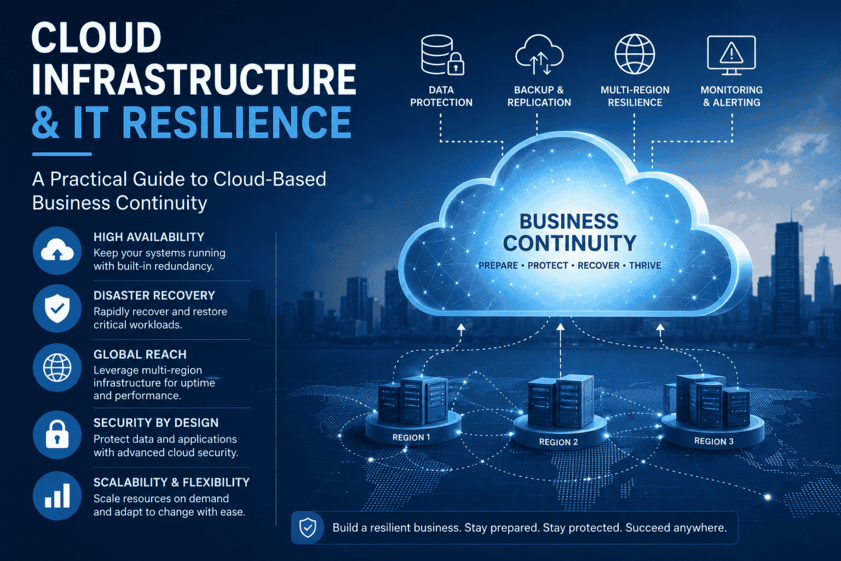
Cloud Infrastructure & IT Resilience for Texas Organizations
Texas is no stranger to disaster. The catastrophic power grid failure during Winter Storm Uri in 2021, the devastation of Hurricane Harvey, relentless tornado activity across North Texas, and an escalating wave of ransomware attacks targeting businesses of every size all point to a uniquely complex risk environment. Yet many Texas businesses remain dangerously underprepared when it comes to protecting their most critical asset: their data and IT systems.
Disaster Recovery as a Service (DRaaS) leverages cloud infrastructure to replicate systems and restore operations in minutes rather than days, without the cost and complexity of traditional disaster recovery approaches. This guide covers why disaster recovery as a service for Texas businesses is no longer a luxury for large enterprises. For any Texas organization that depends on technology to operate, serve customers, and compete, it’s a practical necessity.
The Texas Business Threat Landscape
Texas businesses face a convergence of risk factors more varied and severe than in most other states.
Natural Disasters
Texas is consistently ranked among the most disaster-prone states in the nation. The Gulf Coast faces annual hurricane season exposure, with cities like Houston, Corpus Christi, and Beaumont experiencing direct impacts in recent memory. Winter storms, once considered rare, proved catastrophic in 2021 when Uri knocked out power across the state for days, leaving millions of residents and thousands of businesses without electricity, heat, or internet connectivity. North Texas faces regular tornado activity, while flooding, the deadliest weather hazard in the state, affects Austin, San Antonio, and Houston annually. In West Texas and the Hill Country, wildfires increasingly threaten infrastructure and operations.
Cybersecurity Threats
Texas sees some of the highest ransomware and data breach activity in the country. In 2019, a coordinated ransomware attack simultaneously targeted 22 Texas local government entities, demonstrating that attackers are willing and able to strike multiple organizations at once. Since then, hospitals, school districts, law firms, and private businesses across the state have faced escalating cyberattacks. As more operations have moved online and organizations have adopted cloud tools, the attack surface has expanded significantly.
Infrastructure Vulnerabilities
Unlike most U.S. states, Texas operates its own independent electric grid managed by ERCOT. While this provides some regulatory flexibility, it also means that when the Texas grid fails, there is no mechanism to draw power from neighboring states. The 2021 storm made clear that this vulnerability is not theoretical.
Key Statistic: According to FEMA, 40% of businesses do not reopen after a disaster, and another 25% fail within one year.
What Is DRaaS, and How Is It Different from a Backup?
Disaster Recovery as a Service is a cloud-based approach to business continuity. Rather than maintaining a costly secondary data center or relying on infrequent tape or disk backups, DRaaS continuously replicates your IT infrastructure (servers, applications, and databases) to a secure cloud environment.
When a disaster occurs, your business can fail over to that cloud environment and continue operating, often within minutes. Once your primary systems are repaired and tested, everything synchronizes back automatically. The entire process can be automated and executed according to pre-defined recovery plans, without requiring manual intervention at the worst possible moment.
A backup alone is not a disaster recovery strategy. Here’s how the two approaches compare:
| Feature | Traditional Backup | DRaaS |
| Recovery Time | Hours to days | Minutes to hours |
| Data Loss Risk | High (last backup only) | Near-zero (continuous sync) |
| Failover Process | Manual, error-prone | Automated & orchestrated |
| DR Testing | Rarely performed | Scheduled & documented |
| Cost Model | High CapEx | Predictable monthly OpEx |
| Off-site Protection | Manual or tape-based | Automatic cloud replication |
The Real Cost of Downtime for Texas Businesses
One of the most effective ways to evaluate DRaaS investment is to calculate what downtime actually costs. Industry research consistently estimates downtime costs at $8,000 to $74,000 per hour for mid-sized businesses. Large enterprises can face losses exceeding $300,000 per hour during critical outages. Even small Texas businesses routinely face five-figure losses in a single extended outage when you factor in lost revenue, idle employee time, emergency IT costs, and customer attrition.
Beyond the immediate financial hit, there are significant hidden and long-term costs:
- Customer churn and damaged client relationships that take years to rebuild
- Reputational harm, particularly for businesses in healthcare, legal, and financial sectors where clients expect consistent data reliability
- Regulatory fines for failure to protect or restore access to sensitive data under HIPAA, PCI-DSS, or other frameworks
- Lost competitive advantage while your business recovers and competitors remain fully operational
- Potential legal liability for data loss affecting third parties
Texas Industries That Depend on DRaaS
Certain Texas industries face regulatory requirements or operational realities that make DRaaS especially urgent.
Healthcare
Texas is home to one of the world’s largest medical complexes. Healthcare organizations must comply with HIPAA’s strict requirements for data availability, integrity, and confidentiality. A ransomware attack or flood that takes down patient records is both a patient safety issue and a federal compliance violation. DRaaS ensures clinical and administrative systems can be restored quickly while maintaining the audit trails regulators require.
Energy and Oil & Gas
The Texas energy sector is a significant driver of national supply. As operational technology (OT) and IT systems converge across pipelines, refineries, and drilling operations, cybersecurity risks have escalated sharply. A successful attack on energy infrastructure carries implications well beyond business continuity. DRaaS helps energy companies maintain operational resilience across both IT and OT environments.
Legal and Financial Services
Law firms, CPA practices, and financial advisors across Austin, Houston, and Dallas manage extraordinarily sensitive client data. Losing access to that data, even briefly, can violate client obligations, state bar rules, and SEC or FINRA regulations. For these firms, DRaaS is as much a professional responsibility as it is a technology investment.
Manufacturing and Logistics
Texas has major ports, rail hubs, and distribution centers operating on just-in-time principles. ERP systems, warehouse management platforms, and inventory databases must remain continuously available. A single day of downtime during peak operations can cascade into weeks of supply chain disruption.
DRaaS as a Ransomware Defense
DRaaS isn’t only protection against hurricanes and power outages. It’s one of the most effective defenses against ransomware. When attackers encrypt files and demand payment, businesses without a clean recovery option face an impossible choice: pay the ransom with no guarantee of recovery, or rebuild from scratch and lose weeks of productivity.
With a properly configured DRaaS solution in place, the calculus changes:
- Systems can be restored to a clean, pre-infection state within hours
- Isolated cloud snapshots remain out of reach for attackers who have compromised your primary environment
- Recovery time is measured in hours rather than days or weeks
- You avoid funding criminal enterprises through ransom payments
- Your cyber insurance premiums may be reduced if you can document a tested recovery capability
Texas’s prominence as a ransomware target makes this especially relevant. The 2019 coordinated attack on 22 Texas municipalities was an early signal that attackers view the state as fertile ground. Healthcare providers, school districts, county governments, and private businesses have all been targeted in the years since, and the pattern has not reversed.
Key Features to Look for in a DRaaS Provider
Not all DRaaS solutions deliver equal protection. When evaluating providers, Texas businesses should ask specific questions and look for concrete capabilities.
Geographic Redundancy
Ensure your provider maintains data centers outside of, or distributed across, Texas. A provider whose only facility is in Houston offers no protection from a Gulf Coast hurricane. True resilience requires replication to geographically distant infrastructure.
Automated Failover and Runbook Orchestration
Manual recovery processes introduce human error and delay when speed is most critical. Look for platforms that automate the failover sequence based on pre-tested runbooks. The goal is a repeatable, documented process that works at 2 AM during a crisis, not one that depends on your best engineer being available and alert.
Tiered RPO and RTO Options
Different systems have different recovery requirements. Your customer-facing platform may need a 15-minute RPO, while an internal HR system might tolerate a 4-hour window. A DRaaS provider with tiered service levels lets you calibrate protection for each workload without overpaying.
Regular, Documented DR Testing
An untested disaster recovery plan is no plan at all. Require providers to conduct scheduled, non-disruptive DR tests, at least annually and ideally quarterly, and produce documented results. This not only validates your recovery capability but satisfies auditors and regulators who require proof of testing.
Compliance Alignment
If your business operates in a regulated industry, your DRaaS provider must understand and support the relevant compliance frameworks, including HIPAA, PCI-DSS, SOC 2, NIST 800-171, CMMC, or others. Ask for documentation of their certifications and how their solution supports your specific compliance obligations.
Pro Tip: Ask any prospective DRaaS provider for real-world recovery documentation from actual DR tests or declared disasters, not just marketing materials. A provider who can show successful recoveries has earned a different level of trust than one who can only show you a diagram.
Common DRaaS Myths, Debunked
“We’re too small to need DRaaS.”
Small businesses are disproportionately vulnerable to downtime because they have fewer financial reserves to absorb losses. A three-day outage that a large enterprise can weather might permanently close a small business. DRaaS solutions are available at a wide range of price points and scale to organizations of any size.
“We already have backups, so we’re covered.”
Backup and disaster recovery are fundamentally different. Restoring from a backup can take days, may leave significant data gaps, and provides no guarantee of a working environment at the end of the process. DRaaS provides a live, continuously updated, tested copy of your environment that can be activated in minutes.
“The cloud isn’t secure enough for our data.”
Enterprise cloud providers typically offer security controls (encryption at rest and in transit, physical access controls, redundant power and network, SOC 2 certification) that far exceed what most small and midsized businesses can maintain in-house. When properly configured, cloud-based DRaaS is more secure than tape backups stored in an office that could be flooded, stolen, or destroyed.
DRaaS Is Business Continuity for the Modern Texas Enterprise
Natural disasters, ransomware, grid failures, and human error have already closed businesses across Texas. These are documented, recurring events, not hypothetical scenarios. For organizations that don’t yet have a tested, documented recovery strategy, the right time to build one is before the next storm, the next ransomware campaign, or the next grid failure forces the issue.
DRaaS converts what could otherwise be a fatal disruption into a manageable, time-limited setback. Learn more about how Texas organizations are approaching this challenge by exploring this resource on disaster recovery as a service for Texas businesses, and take the first step toward building a recovery strategy that holds up when it matters.
Ready to assess your current recovery posture? A qualified managed IT provider with DRaaS expertise can help you identify gaps, define recovery objectives, and deploy a solution scaled to your organization.
Leave a Reply