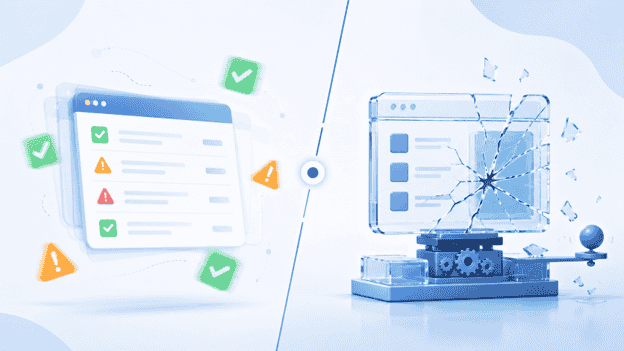
Test failures slow teams down, but not all failures mean the same thing. Two of the most common problem types a tester encounters are flaky tests and brittle tests. They look similar on the surface, both producing unreliable results, but they fail for different reasons and require different fixes. aqua cloud covers both problem types and gives QA teams a single place to track, manage, and act on test quality issues.
What Are Flaky Tests?
Flaky tests are tests that produce inconsistent results without any change to the code under test. They pass on one run and fail on the next, even when the application itself has not changed. This unpredictability makes them particularly difficult to diagnose, because the failure is not tied to a specific code change. Only the best tool for flaky test detection can provide usefulness here.
Common Causes of Flaky Tests
- Timing and async issues: tests that rely on fixed delays or wait for async operations without proper synchronization
- Test order dependency: tests that pass only when executed in a particular sequence
- Shared mutable state: global variables or database records modified by one test and left dirty for the next
- External service dependency: calls to third-party APIs or services that are occasionally slow or unavailable
- Environment inconsistency: differences in OS, timezone, locale, or available memory across machines
- Random or date-based logic: tests that generate random input or compare against the current date without controlling for it
Examples of Flaky Test Behavior
A common example is a UI test that clicks a button before the page has fully loaded. The test passes when the server responds quickly and fails when it is slightly slower. Another example is a test that checks whether an email notification was received, where delivery timing varies by environment.
Impact of Flaky Tests on QA
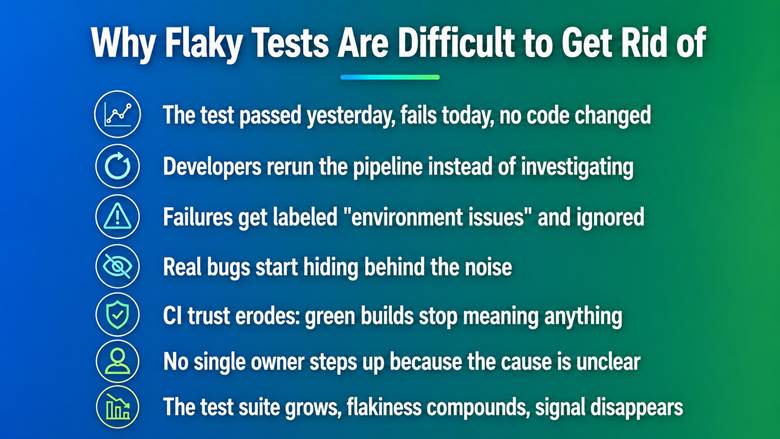
Flaky testing erodes trust in the test suite. When engineers see failures they cannot reproduce, they start ignoring red builds. Over time, real bugs slip through because the team has learned to dismiss failures as noise. CI pipelines slow down due to repeated reruns, and QA bandwidth gets spent investigating non-issues. Using a dedicated best tool for flaky test detection helps teams spot patterns across runs and separate genuine failures from noise automatically.
What Are Brittle Tests?
Brittle tests are tests that break whenever the application changes, even when the underlying behavior being tested is unchanged. They are tightly coupled to implementation details such as CSS selectors, element IDs, or exact string values that have no bearing on the correctness of the feature.
Common Causes of Brittle Tests
- Hardcoded selectors: tests that locate elements by a specific XPath or CSS class that changes with UI updates
- Exact string matching: assertions that check for an exact error message or label that gets reworded
- Tightly coupled test data: tests that depend on specific record IDs or database states that change between runs
- Overly specific assertions: checking the full structure of a response object when only one field matters
- No abstraction layer: test logic written directly against raw implementation details without a page object or service layer
Examples of Brittle Test Behavior
A tester writes a test that selects a button using the XPath /html/body/div[3]/button[2]. A developer later wraps that section in an additional container div, and the test fails even though the button still works correctly. Another example is a test that asserts a response contains the string “Operation completed successfully”. Once that message gets reworded to “Done”, the test breaks with no actual regression in the product.
Impact of Brittle Tests on QA
Brittle testing creates a high maintenance burden. Every UI refresh or minor refactor triggers a wave of test failures that have nothing to do with broken functionality. QA teams spend time updating selectors and adjusting assertions instead of writing new coverage. This overhead compounds quickly on teams shipping frequently.
Flaky vs Brittle Tests: Key Differences
| Factor | Flaky Tests | Brittle Tests |
| Failure pattern | Inconsistent, passes and fails without code changes | Consistent, always fails after a specific change |
| Root cause | Non-determinism in test execution environment | Tight coupling to implementation details |
| Reproducibility | Hard to reproduce reliably | Easy to reproduce after a triggering change |
| Tester effort to diagnose | High, requires log analysis and repeated runs | Low, the breaking change is usually traceable |
| Fix approach | Stabilize async handling, isolate state, control environment | Add abstraction layers, use stable selectors, loosen assertions |
| Main risk | Suppressed failures, ignored alerts | High maintenance cost, slow delivery |
| QA signal quality | Degrades over time | Drops sharply after each application change |
Both problem types reduce the reliability of a test suite, but through different mechanisms. Flaky tests undermine confidence through randomness. Brittle tests undermine efficiency through fragility.
Conclusion
Flaky tests and brittle tests are distinct problems that call for distinct solutions. Flaky testing is a signal to examine test isolation, timing, and environmental dependencies. Brittle testing points to structural issues in how tests are written and how tightly they bind to the application’s internals. A QA team that can tell the two apart will spend less time chasing phantom failures and more time building coverage that delivers a reliable signal.
Leave a Reply